D4S Insight Report A.5
Advances in mapping available tropical peatland carbon stock from GDEL
For obtaining carbon credits from peatland restoration, detailed maps of peat carbon stock available for emissions are needed for project areas. Such maps are not available in the public domain. Project-based maps are highly variable in quality and rarely consider the carbon stock that is actually available for emission. What is the most confident approach?
Some considerations based on our experience and insights:
How is tropical peat carbon stock determined?
Usually, peat carbon stock is determined by calculating peat volume from a peat thickness map, and then multiplying the volume by a carbon density parameter. However, tropical peat has greater spatial variation in carbon density than peat in colder climates, which introduces uncertainty. Moreover, part of the peat carbon stock is often not available for emissions as it is below levels where it could be drained; this distinction is rarely determined.
What causes variation in peat carbon density, and how is it determined?
Tropical peat in SE Asia mostly consists of different types of accumulated tree matter that have different densities: wood, roots and leaves. Peat bulk density, and therefore carbon density, varies with sample composition. Auger sampling increases this variation by disturbing such peat, creating voids and compression. Moreover, vertical trends in bulk density exist, that are different in natural and drained areas. This variation can be measured by sampling the peat in vertical pits instead of augering, but this is a specialist approach that is rarely applied.
How is available carbon stock determined?
The carbon stock that is available for emission is positioned above the drainage base, which is the lowest level to which water can be removed from the peat, causing peat decomposition into CO2 and other emission components. Peat below the drainage base can not decompose.
How is the drainage base determined?
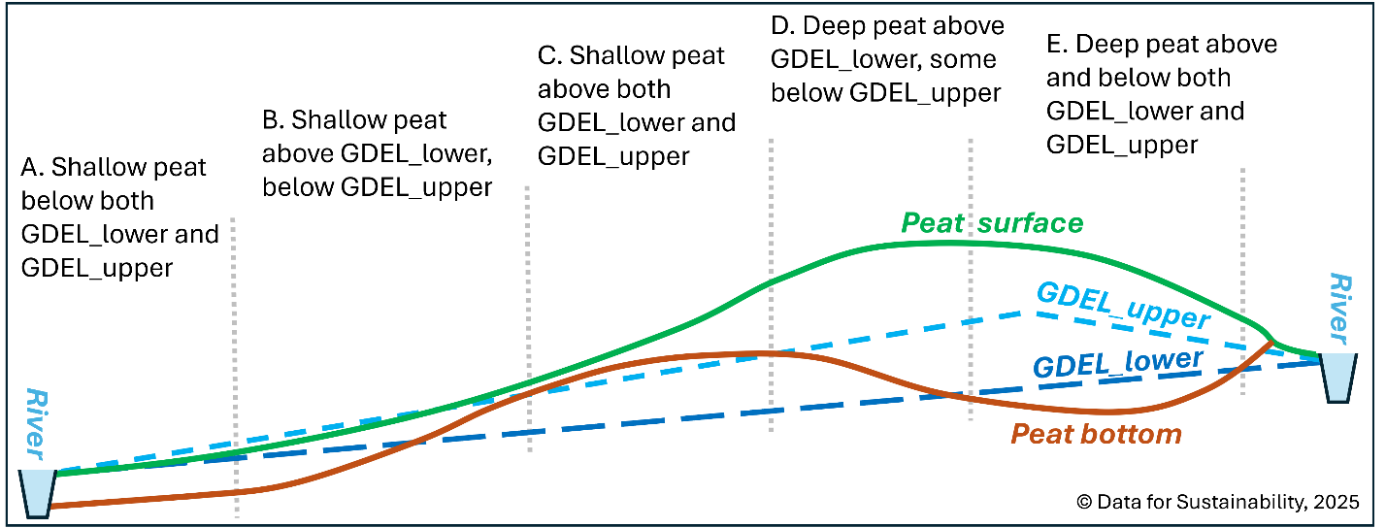
We refer to the drainage base as the Gravity Drainage Elevation Limit (GDEL; see Figure 1). We distinguish two main GDEL levels: [1] GDEL_upper below which drainage by gravity becomes increasingly impeded, and [2] GDEL_lower below which the peat would be water saturated most of the time in any management scenario (that does not include mechanical pumping) and the carbon store is stable. The GDEL_upper level is calculated from GDEL_lower, usually by applying drainage gradients of 10 to 20 cm/km, starting at coastline and rivers.
How are available carbon stock and Peat Depletion Time determined from GDEL?
The difference between the peat surface and GDEL_lower presents the maximum amount of peat carbon that is available for oxidation and, therefore for crediting. In the range between GDEL_upper to GDEL_lower, peat decomposition and carbon emission gradually decreases to zero as peat surface subsidence proceeds. The speed of this decrease depends on the drainage management response – some plantations will invest in drainage improvements until inundation becomes inevitable (resulting in high emissions until GDEL_lower is reached), others will abandon the area soon after flooding issues start. To predict the rate of peat loss, a projection of expected (hypothetical) drainage management response to the peat surface dropping below the GDEL_upper is required to predict the Peat Depletion Time (PDT) as required by Verra methodologies.
How is GDEL determined?
D4S has developed an approach that determines the local Mean Sea Level (MSL), GDEL_lower and River Flood Risk (RFR) levels from satellite LiDAR measurements of coastal (sea) and river water surface elevation (WSE), where MSL is represented by the mean value found over coastal waters and GDEL_lower by the 75-percentile WSE. The 75-percentile WSE presents the level that is exceeded by coastal/river levels for 25% of the time i.e. 3 months per year on average; few crops could survive such conditions. This level is interpolated between rivers and coastline to define a full GDEL_lower surface. This method was applied successfully to several recent peatland emission reduction projects, and will be published in the scientific domain. Figure 1. Schematization of lower (GDEL_lower) and upper (GDEL_upper) drainage elevation limit in relation to the peat surface and peat bottom, as derived from river water level statistics. Below GDEL_upper drainage becomes gradually impeded, and below GDEL_lower the peat would be water saturated and stable in any scenario.
Selected Further Reading (D4S Publications)
-
Mapping deep peat carbon stock from a LiDAR based DTM and field measurements, with application to eastern Sumatra
-
Benefits of tropical peatland rewetting for subsidence reduction and forest regrowth: Results from a large-scale restoration trial
-
Flooding projections from elevation and subsidence models for oil palm plantations in the Rajang Delta peatlands, Sarawak, Malaysia